- admin
- Digital Transformation, Future of web, Web Application, Website
- 0 Comments
- 17589 Views
Your Business Has Changed. Has Your Technology?
Businesses often outgrow the systems they started with. A process that worked well in the beginning can become harder to manage as the business gets more customers, more employees and more information to handle.
Teams may start using additional spreadsheets, moving enquiries between the website and CRM, or keeping customer details across different platforms. Nothing may be completely wrong with the existing setup, but it can gradually create more manual work than it should.
The business has moved forward, and the way its technology is being used may need to move with it.
Outdated Doesn't Always Mean Old
A five-year-old system isn’t automatically outdated, just as a system built last year isn’t necessarily the right fit for a growing business.
Technology becomes outdated when it no longer supports the way a business operates. A company may have started with a simple website, email and a spreadsheet when it had only a few customers.
As the business grows, there may be more customers, employees, enquiries, orders, payments and information to manage. The same process can then involve multiple people and systems, creating more work than it originally did. In many cases, the software hasn’t failed; the business has simply outgrown the way it was using it.
The Hidden Cost Is Usually Manual Work
Manual work is often one of the first signs that a business’s systems need attention. For example, a customer may submit an enquiry through the website, which someone then has to enter into the CRM before notifying the right person and creating a follow-up reminder.
When this happens across dozens of enquiries, employees can spend a significant amount of time moving information from one system to another. It also increases the chances of missed follow-ups, duplicate customer records, incorrect information or outdated reports.
These costs may not appear as a separate expense, but they can add up through the time spent managing information and correcting avoidable errors.
Your Website May Be Doing More Than You Think
A website often starts as a simple way to present a business online. As the business grows, however, it may begin handling enquiries, bookings, payments, forms, customer accounts, orders and other business processes.
At that point, the website has become an important part of how the business operates. As these requirements increase, the existing setup may need to change as well. Instead of continuing to add plugins, tools or manual workarounds, it can be useful to look at how the different parts of the system work together.
This could mean improving the WordPress setup, adding an API integration, or connecting the website with a CRM or payment system. In some cases, a business may eventually reach the point where a custom web application makes more sense. The right technology should be based on the business requirement, not the other way around.
The Bigger Problem: Systems That Don't Talk
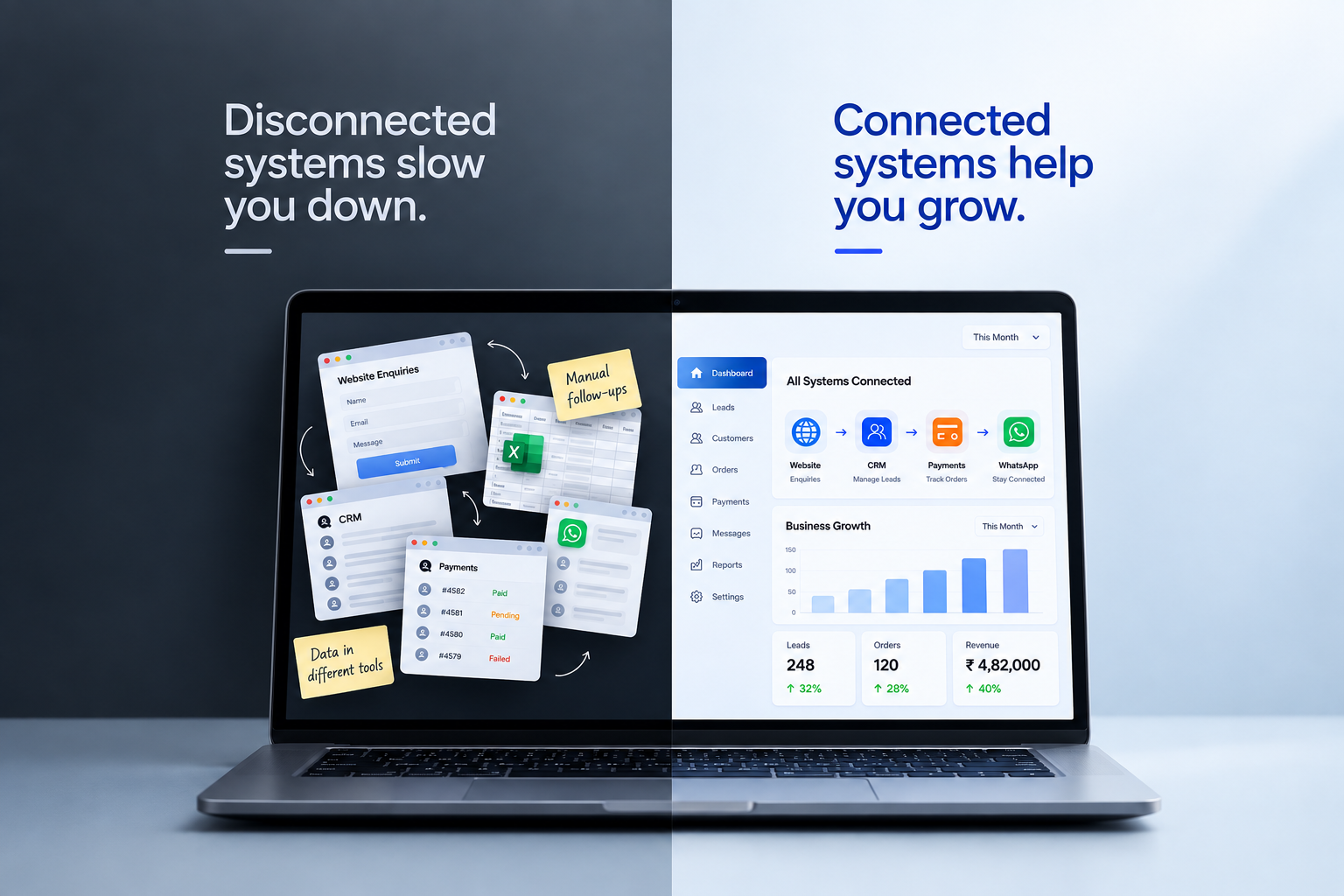
A business may have a website, CRM, payment gateway, accounting software and WhatsApp set up, but if these systems don’t share information with each other, the team often has to manage that gap manually. Enquiries may need to be moved from the website to the CRM, orders may need to be entered into an invoicing system, and customer updates may have to be sent separately.
Connecting these systems through APIs and integrations can reduce this manual work and make information flow more smoothly between them. The goal isn’t to add more software, but to make the systems already being used work together more efficiently.
So, Do You Actually Need New Software?
Not necessarily. Sometimes an integration can solve the problem, while in other cases automation can remove repetitive work or an existing website may simply need to be improved. A CRM might need to be properly connected to the website, or a dashboard could bring important information together in one place.
In some situations, the existing setup may have become too complicated and a custom web application could be a better option. There is no need to replace technology simply because something newer is available. A more useful question is whether the current technology is still helping the business operate efficiently or whether the team has started working around it.
The Webster Solutions Perspective
At Webster Solutions, we don’t believe every business needs to replace its existing technology.
The first step is understanding where the current setup is creating unnecessary work. In some cases, improving the website or connecting a CRM, payment or communication platform may be enough.
In others, automation or a custom web application may be a better fit. The goal is to use technology to make everyday business processes easier to manage and support the way the business operates.
Ready to find the right technology solution for your business? Book a free strategy call with us — let’s talk about what’s working, what could be better, and what you want to build next.